• Lunatic Writer
  • Novels & Novellas
    • Big Ledge Front
    • Big Ledge Back >
      • Big Ledge Review
      • Big Ledge More Reviews
      • Chicken Thief
      • Heaven
    • Loose Ends >
      • Loose Ends Back >
        • Loose Ends Interview
        • Reviews
    • Lunatics >
      • Lunatics: Reviews
      • Lunatics: Closer Look
    • The Draper Catalogue >
      • Reviews
    • Eta Carinae >
      • Reviews
    • Echoes
    • Letters to Icarus >
      • Letters to Icarus: a review
    • Willing >
      • Willing: Reviews
    • Book Reviews
  • Short Fiction
    • All Saints Day
    • Sweet Melancholy
    • More Short Fiction
  • Drama
    • Willful Pursuits
    • More Willful Pursuits
    • Sproule's Folly
    • Gravity
    • Audio Drama
    • All the World's a Stage
    • Theatre Reviews
  • Astro
  • Author's Blog
  • Comments & Contacts
  • Res Naturae
    • Valhalla Provincial Park >
      • Gwillim Lakes
    • Record Ridge
    • Skattebo
    • Rock Slide Lake
    • Kootenay National Park >
      • Juniper
      • Marble Canyon
      • Paint Pots
      • Cobb Lake
      • Redstreak
      • Stanley Glacier
    • Waterton Lakes National Park >
      • Bear's Hump
      • Red Rock Canyon
      • Bertha Lake
      • Wall Lake
      • Prince of Wales
    • Old Growth Forest
    • Ripple Ridge
  • Abroad
    • Jamaica >
      • Aerial Creatures
      • Land Creatures
      • Ocean & Beach
      • Miscellaneous
    • France >
      • Paris I
      • Le Sud
      • Paris II
    • Oregon >
      • Washington
      • Cannonbeach
      • North Coast
      • Portland & Corvallis
      • Central Coast
      • Ashland
      • Crater Lake
      • Mt. Rainier
    • Belize >
      • Birds of Belize
      • Daily Life
      • Water Scenes
    • Greece >
      • Athens
      • Hydra
      • Argolid
      • Crete
      • Santorini
      • Mykonos & Delos
      • Delphi
    • Canyon Country >
      • Red Rock Canyon
      • Valley of Fire
      • Zion NP
      • Bryce Canyon NP
      • Grand Canyon
      • Sedona
    • Cuba >
      • Varadero
      • Jeep Tour
      • Havana
    • Cozumel >
      • All-Inclusive
      • Island Tour
      • Tulum
      • About Town
    • UK & Ireland >
      • London >
        • Ealing
        • Tower of London
        • Westminster
        • British Museum & the Eye
        • Thames & Greenwich
        • Victoria & Albert Museum
      • Northwest >
        • Grasmere
        • Chester
        • Liverpool
      • Southeast >
        • North Marston
        • Oxford
        • Hughenden Manor
        • Brighton
      • IRELAND >
        • Dublin
        • Killarney & Dingle
        • Muckross
      • York
      • West Midlands >
        • Hereford
        • Shrewsbury
      • Wales
      • Southwest >
        • Bath
        • Cornwall
    • Arizona >
      • Phoenix
      • Biosphere
      • Tucson
      • Nogales
      • Tombstone
      • Chiricahua
      • Kitt Peak
      • Casa Grande
  • I See You
  Lunatic Writer

Thomas Hammill, Sinner or Saint?

11/25/2012

2 Comments

 
Picture
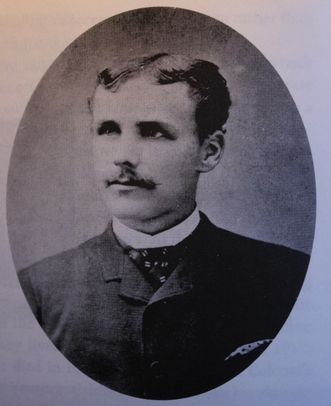
Thomas Hammill was born in Cornwall, growing up in a tradition of hard rock mining and smuggling. Concerning his physical appearance, one man described him as “too neat, too nattily dressed for the frontier.”  Nevertheless Hammill was an experienced prospector who, like Sproule himself, had been all over North America seeking his lucky strike.

Sometime during the morning of June 1, 1885, while working on his portion of the Bluebell Mine, Thomas Hammill was shot in the back. He died within an hour of being discovered.

Six months later, at a courtroom in Victoria, the murdered man was described in quite glowing terms by some of the men who worked for him. And, said one of the witnesses, he didn’t know of anyone who held anything against Hammill, except the accused, Robert Sproule.

Later, a witness for the defense, claimed to have known Hammill when he was in Colorado, and claimed he was notorious for being a claim jumper, even back then.

In 1884 Judge Begbie of the Supreme Court of British Columbia supported this assertion,  describing Hammill’s actions at Big Ledge in the preceding year as “simple claim-jumping.”  The judge ruled against Hammill and returned the Bluebell claim to Sproule.


So what kind of man was Thomas Hammill, really?  Like Sproule, he seems almost to have had almost a split personality.  Competent, ambitious, likeable (to some at least), and quite possibly unscrupulous.  Early in 1882, he joined the employ of John C. Ainsworth of Oakland California, thereby irrevocably tying his destiny to the convoluted actions about to unfold north of the border.

More about Ainsworth in the next post...


To learn more about the Big Ledge project, click HERE.
2 Comments

The Mysterious Modulating Surname

11/17/2012

0 Comments

 
Picture
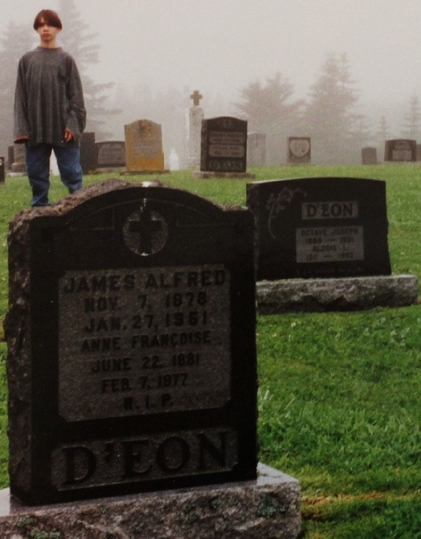
cemetery in Middle West Pubnico


Deon or d’Eon?
Which and why?

      My surname is one of just a few you will find in the town of  Pubnico, Nova Scotia.  This is a town whose background has been, up until recently, almost exclusively Acadian.   Other prominent family names you’ll find in the area are D’Entrement,  Amirault, Nickerson and Doucette.  The D’Entrements first settled the area way back in 1651.  My father, Roderick Joseph, was the eldest son to Joseph D’Eon and Eveline D’Entrement.

     To the best of my understanding, the spelling of surnames (and other words, for that matter) was largely in a state of flux in the 17th century in both England and France, so to find several variant spellings of a name or word was not unusual.  Thus d’Eon, D’Eon, and even D’eon could be, and can still be, found.

            At some point in my father’s young life—I believe it was when he first enlisted in the Navy—he decided he had had enough with people misspelling and mispronouncing his name. Where does that apostrophe go? And how do you say your name again? So he decided to simplify it to “Deon”, no apostrophe, no silent letters, nothing could go wrong.

            Of course, the irony is that, today, when I tell my name to strangers, they first think, oh that must be “Dion”, right? No?  Well, then “Dionne” like the quintuplets?

Not exactly what my dad had in mind, I think…

            In any case, whether he meant to or not, my father’s dropping of the apostrophe, read as a not so subtle snub of his Acadian ties. Again the Canadian Navy of World War II was likely at fault.  Unquestionably there was a prejudice against recruits with a French background at this time. So my father probably had good reason not to advertise his Acadian origins.

            I grew up in a very different world. Today the Acadian flag flies proudly throughout settlements all over the Maritime provinces of Canada and no one seems especially anxious to dispose of their apostrophes.

            So, when I began publishing material, whether as the author of plays or short stories, magazine articles etc., I decided to give myself a pen-name--but not really a pen name--because I simply fell back to the family’s traditional spelling. And, after all, what is cooler than having an apostrophe in your name?  

            Interestingly, I just came across some information (thanks to a distant D’Eon relative still living in Pubnico) that adds yet a new twist to the story, and  which explains that the original family surname was Duon (with no apostrophe). But an enterprising (if misguided) sea captain of 19th century Pubnico, decided to add one on, and transform one of the vowels, hence, d’Eon.

And so, I’m afraid, it’s likely to remain! (unless my own children decide to become surname mavericks and revert to the more ancient “Duon”.)

For a more complete explanation to this convoluted story, check this: http://www.geocities.com/teddeon509/duondeon.html


0 Comments

Lunatics Update

11/16/2012

1 Comment

 
Picture
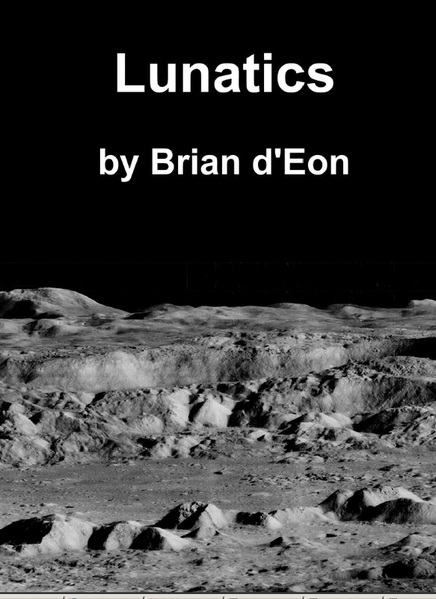
Publishers who have rejected the manuscript:  7

Publishers who have not yet responded: 7


Mental health of author (/10):  7


1 Comment

Robert E. Sproule

11/15/2012

0 Comments

 
Picture
          Sproule (rhymes with “coal”) is the central character of Big Ledge.  Born in Weeks Mills, Maine, like many young men of his generation, he was drawn to the lure of gold and instant wealth, promised in the bonanza discoveries all across North America in the 1800’s.

       Sproule had prospected in Colorado, Arizona, Oregon, Washington Territory. There are even reports that he spent time in South America and possibly South Africa, looking for diamonds. He’d come close in Oregon. He’d found a promising deposit of coal near Tacoma, but rival interests apparently “framed” him on a charge of arson and forced him to leave or face the possibility of imprisonment.

            In the Kootenay District Sproule was convinced his luck had finally changed. His claim was clearly prior to anyone else’s. And any idiot could see that Big Ledge was tremendously rich in lead and probably some silver as well. There were technical difficulties, for sure.  There was no easy route to the mine site. No apparent way to move the ore out. And Sproule, personally, had none of the financial resources necessary to build the needed infrastructure.

            Nevertheless, Sproule was certain he could build his fortune here. It came as quite a shock that, within weeks of his initial claim, rivals were hot on his heels,  a syndicate of prospectors and businessmen headed by John C. Ainsworth of Oakland California. They had big plans for the area, which included not just staking out as many mining claims as possible, but building rail lines and putting steamboats on Kootenay Lake. In a very palpable way, things had set themselves up as a David vs. Goliath story at Big Ledge.

            To my knowledge there is no existing photograph or portrait of Sproule.  He seems to have had no distinguishing physical features but he is variously described as strong, a good worker, a tough mountain man, and an experienced miner.  Most important perhaps is his age. He was forty-something when he first came to Big Ledge, at least ten years older than most of his peers. He would have been considered an “old-timer” by the young bucks and, in his own mind, he must very much have regarded Big Ledge as his last chance to strike it big.

            There is much disagreement about Sproule’s character. His friends describe him as reliable, trustworthy, a good worker, knowledgeable.  Hendricks, who became his great financial backer in 1884 had no hesitation in hiring him as his superintendent of mining operations.

            His enemies, however, paint a very different picture. They describe Sproule as a man of unpredictable movements, vengeful, argumentative. Indeed some describe him as a criminal, not only guilty of arson, but probably murder too—more than one.

            There seems little doubt that Sproule had an intense dislike of Thomas Hammill who just before the close of the mining season in 1882, jumped his claim. His many threats against Hammill’s life are well documented. So when, on June 1, 1885, Thomas Hammill was found shot in the back, Sproule immediately became the prime suspect.

            All the evidence against him proved to be circumstantial and,  right to the moment before his hanging, Sproule continued to profess his innocence.

            Who was the “real” Sproule?  And what exactly happened on the day of the murder? That is the work of Big Ledge to explore and hopefully for my readers to enjoy.


Want to read the the start of the novel?   Click HERE!
0 Comments

Geography of Big Ledge

11/10/2012

0 Comments

 
Picture
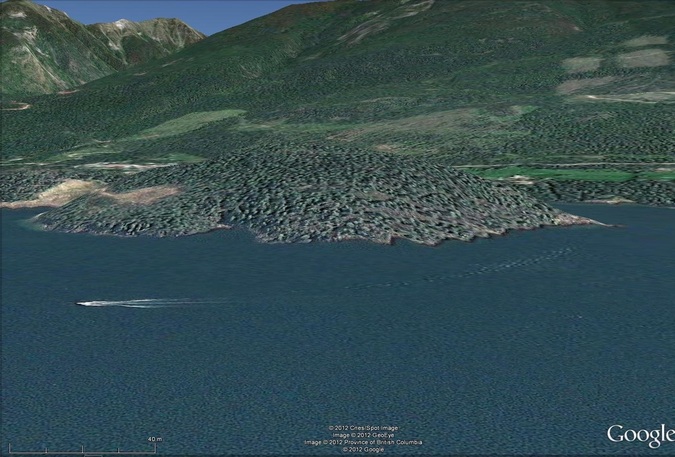
Big Ledge viewed from the west
                                                            

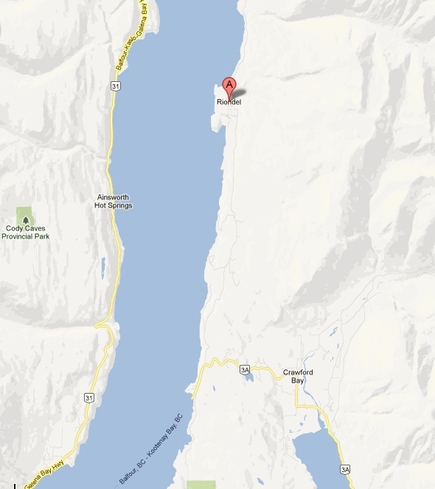
            Big Ledge, just outside present day, Riondel, is the nickname given to the ledge of rock (or promontory) that conspicuously sticks out into Kootenay Lake about two-thirds of the way up from its southern extremity.  A series of hills fills this promontory rising to about 100 metres from lake level. Historically this “ledge” could also be recognized by the prominent brown stains on its rock outcrop.  A century of mining activity has pretty much put an end to that identifier however

            Although Big Ledge was long known to the aboriginal people of the area, it took till the early 1800s before it came to the attention of white folk. And this mostly, just in passing. From the beginning, people understood this promontory might be good place to extract lead--for making bullets, for example. But it was a damned difficult place to get to. And with no infrastructure anywhere nearby,  no one could see any way to turn this knowledge into a money-making venture.

            The situation changed dramatically with the advent of the railway. By 1882, trains were pulling into Sandpoint, Idaho, not far from the Canadian border and the south shore of Kootenay Lake. By this date, plans were already underway for the great Canadian Pacific as well (though it would not pass nearly so close to Big Ledge). And one John C. Ainsworth of Oakland California was proposing to build a short spur line to link Kootenay Lake to the Columbia River as a means of moving ore, supplies and people.  Suddenly Big Ledge, and the lead and silver buried in its rocks, had become accessible.


Picture
Hot Springs, sometimes referred to as Warm Springs, and finally Ainsworth Hot Springs, was the first settlement developed in the West Kootenay. It was built in direct response to the mining claims made over at Big Ledge, four miles across the lake in 1882.   The Ainsworth Syndicate, of Oakland California, made this their base camp. From here they addressed mining interests on both sides of the lake. It was also their hope that this settlement, or some place nearby, would soon become the terminus for their planned railway spur line.

It is between these two points, separated by just four miles of water, that the core of my story takes place, with Thomas Hammill and his boys, based at the hot springs, and Sproule and his confederates holed up on the promontory.  These were marvelous, magical places back then and remain so today, and like two terminals in a battery, a whole lot of electricity flowed between them.


Picture
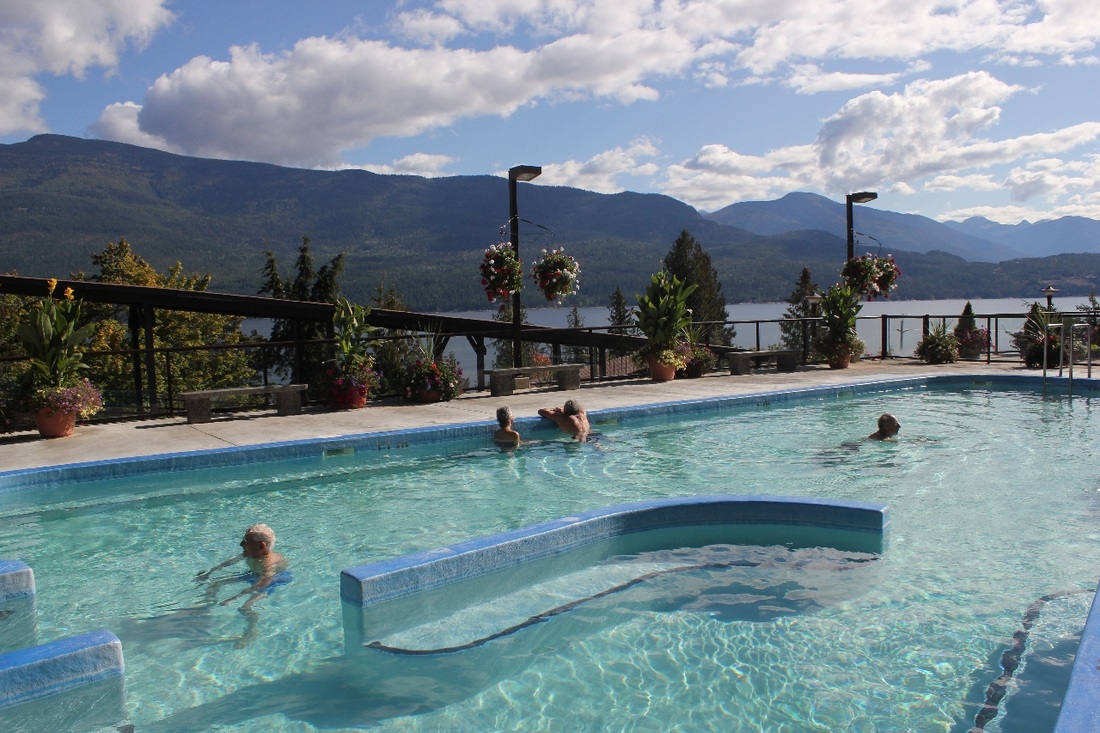
The hot springs today
0 Comments

Getting Started with Big Ledge

11/4/2012

0 Comments

 
Picture
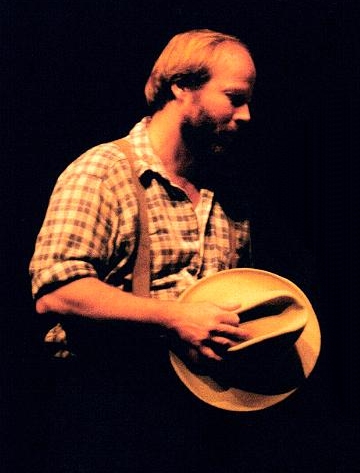
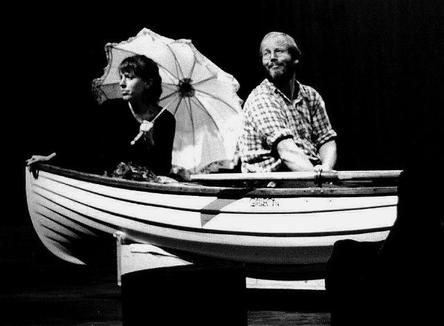
from the play, Sproule's Folly: Sproule with Lily Langtry.
Big Ledge and the Murder at the Bluebell Mine


“How did you get your idea for writing this book?”  This is a question often put to authors.  Somewhat to my surprise, my answer to this question would be almost the same for both Lunatics, which I finished last year, and Big Ledge which I’m currently working on.

In both cases, the books were not born of inspirational moments.  Rather they emerged more as a response to long nagging ghosts.  The character of Wernher von Braun had haunted me for several years.  Since the time I followed up a footnote about him while working on my play Gravity.  Soon I was obsessed.  I  wrote an audio play about von Braun, then an unproduced stage play. Finally I realized only a novel provided a  format big enough to deal with this larger-than-life character.  The Lunatics story is about much more than just von Braun but its original impetus certainly owes much to the feeling I’d long had, that I just hadn’t finished with the man.

A similar tale might be told of Big Ledge whose central character is Robert E. Sproule, an American miner, hanged in 1886 for the murder of Thomas Hammill.  This murder took place very close to where I live, near the present day village of Riondel on the east shore of Kootenay Lake.  I pass by it at least a dozen times a year along the highway on the west shore. From there, sometimes from the comfort of the Ainsworth Hot Springs, I gaze across the four miles of cold water to the lead-laden promontory and  marvel to think, even today, a hundred-and-twenty years later,  the landscape hasn’t changed much.  It would take little imagination to see a miner’s campfire burning in the distance, or to see the wake of a Flatbow canoe pulling in to shore, or hear the sounds of steel picks clanging against  galena ore.

I look across at the site of the Bluebell Mine and remind myself that this is where it all happened, amid this now peaceful demi-paradise.  The early years of the 1880’s marked the moment the first steamboats plied the lake, the first trains skirted its shores, the first log cabins and first towns made their appearance. It was the end of the Age of Innocence as English, Canadian and American interests all collided at once in this undeveloped land full of promise.

Sproule was hanged on circumstantial evidence, despite appeals and petitions from far and wide. He went to the gallows still professing his innocence. His voice still haunts me.  That moment of history still haunts me: that crucial pivot in time when the future may diverge in a thousand different directions (as it does in the beginning of the writing process).  I  can’t rest till I feel I’ve let Sproule have his final say. And, to be fair, I want other characters have their say too.

Big Ledge is a tale of murder, greed, perjury, disappointment and even fantasy.  In its retelling, I hope to finally exorcise some of its ghosts.

0 Comments

Still Waiting...

11/4/2012

0 Comments

 
Picture
Submitting your work can be discouraging--enough to make one grow negligent about blogging! (Mea culpa.)  Still, it must be less stressful than the constant auditioning which actors must do (just ask my daughter) where you must stare rejection in the face on a daily basis. As an author, you can at least fantasize,  for as long as the  reading phase takes, that your work has been well received.

Over time, I am growing a little more thick-skinned. There are a hundred good reasons why a publisher may not choose your work, many of which do not reflect on your worth as a writer.  Much as it is in the actor’s world, where sometimes they’re looking for a very particular “look”, or the director has imagined a particular voice quality which you don’t have, or the producer would feel safer going with a well-known name, factors entirely out of your control are likely to decide your fate. 

Nonetheless, rejection, even the spaced-out, more distant rejections a writer must endure, do take a toll. I find I must allow myself several months between submissions—time enough to the let the echoing rings of rejection fade before I send my stuff out again.

Here's how Lunatics has so far fared: I sent off my first manuscript to a Canadian publisher in November, 2011.  To this date I have not heard back or even received an acknowledgement that the publisher has received my work.  I KNOW small publishing houses are busy, but a couple of sentences in an email? How hard can it be?  I will count this one as a rejection.

A friend suggested I might find more satisfaction from American publishers. Certainly I’ve found more courtesy. Several acknowledged the receipt of my manuscript by email, and two have since informed me that Lunatics doesn’t meet their “requirements” at this time.

(And probably not later either, I suspect.)

So far then, I’ve had three official rejections of out thirteen submissions. Six of my submissions were sent out only in October of 2012, so the wind hasn’t been taken out of my sails completely… And, in the meantime, my novella, Eta Carinae, HAS been accepted for publication. Hurrah for Vagabondage Press!

Of course, just waiting to hear back from publishers is a recipe for insanity. There can be no better remedy than to start a brand new novel, and so I have. And this time, it's a murder story. Based on a true one. Set in the mining camps of British Columbia in the 1880s.  Working title: Big Ledge.


0 Comments

Waiting to be Read

11/4/2012

0 Comments


It has been two months since I left the manuscript for Lunatics with a publisher. After a few weeks, I was notified by the one of the staff they couldn’t find the manuscript; could I send it again? He was going out of town for a couple of weeks and hoped to take it along with him. No problem.

Then, the other day, an email from another person at the office apologizing for not having read my manuscript yet but they were dealing a large backlog of material.


We are experiencing a larger volume of calls than usual. Please hold the line. Your call is important to us. Your call will answered in the order it was received.


All of this is quite normal I suppose. And everyone, everywhere seems to be short-staffed yet somehow expected to operate as if they weren’t.

It is all about waiting.

For me to even hope that my manuscript will be accepted by the first publisher to which it was sent is a testimony to the fact that I CAN be overcome by starry-eyed optimism every once in a while.

Don’t call us; we’ll call you.


Of course, the world cannot or should not stand still as I wait to hear back from a publisher. Already I should be well on my way to other projects. I have managed to write a short story since but, as to tackling anything major, it’s not so easy…

Nobody can have written for any period of time without getting used to rejection, so it’s not so much the rejection that hangs like a dagger before me. It is the uncertainty.

If t’were done, t’were better it were done quickly.


Let me send Lunatics elsewhere and quickly if it is not to find a home with the first publisher.

How many publishers am I willing to send it to? An interesting question. How many times am I willing to suffer rejection?


Dear Mr. d’Eon.

     We found that your story had merit but, unfortunately, it does not fit in with our company’s publishing vision at this time. We wish you the best of luck in submitting Lunatics elsewhere.


The cost of postage is an irritant, to be sure. But a much bigger issue is the waiting. Three months with one publisher, than three to six with the next, another half a year with yet another publisher…  Soon a year has passed, maybe two, and soon your manuscript becomes something quite foreign to you, a child you had long ago put up for adoption, and you have since moved on, and yet you can’t move on. Not completely. Not without at least knowing your child has found a home somewhere, if only in the Orphanage of Unpublished Manuscripts.

Then of course, there is the ‘faux pas’ of simultaneous submissions. Haven’t done it yet, but I doubt I’ll need a lot of arm twisting before I start.


Of course times have changed in the publishing world. They are probably changing faster than most of us realize and self-publishing is increasingly becoming a more sophisticated and affordable option. The question now probably needs to be re-phrased as “how many rejections am I willing to suffer before I publish the damn thing myself?”

I don’t know.

Stay tuned.

Most definitely a lunatic,

B


Picture
Three publishers considering my manuscript.
0 Comments

The Sources (originally posted June 11, 2011)

11/4/2012

0 Comments

 
Picture
The are a huge number of sources available related to the Apollo space program, including many original documents from NASA. They include flight plan checklists, specs for various hardware, lunar maps and full voice transcripts of all the missions. Almost of all of this is available online. It’s enough material to keep many historians busy for many years. Of course, I am no historian, and made no attempt to write a history of the Apollo missions. I dipped into these resources in an attempt to capture the “flavour” of the times, reading some documents in detail but, more commonly, browsing through others, looking for the just the right description or explanation to give the writing a smack of authenticity.

Many astronauts from the Apollo program wrote fascinating books of their own. They provided valuable  background material to help me visualize both the mundane and profound moments in a moon mission. I relied heavily on books by Deke Slayton, Michael Collins, Gene Cernan and flight director, Gene Kranz.

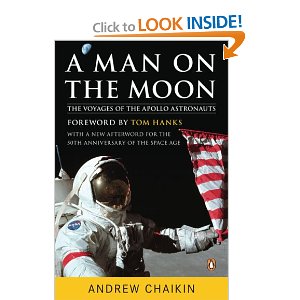
I think I owe my greatest debt to two magnificent, but very different books. One, a recent biography of von Braun, called, Von Braun: Dreamer of Space, Engineer of War, by Michael J. Neufeld.  I had done research on von Braun for several years before bumping into this book. Neufeld’s work easily supersedes everything I had read before and became my bible for filling in the details of the rocket scientist’s life.  Finally there was Andrew Chaikin’s definitive history of the Apollo Program, A Man on the Moon, without which I doubt I could have started on my novel.


Picture
Hopefully I have been able to fuse together the experiences outlined in these many excellent books to create a believable alternate reality. A world in which the reader can explore not only lunar landscapes but the inner ‘mindscapes’ of the book’s principal characters.


Lunatics: Selected Bibliography

Cernan, Eugene and Davis, Don. The Last Man on the Moon. New York: St. Martin’s Griffin, 1999.

Chaikin, Andrew. A Man on the Moon. New York: Penguin Books, 1994.

Collins, Michael. Carrying the Fire: an astronaut’s journey. New York: Farrar, Straus & Giroux, 1974.

Jones, Eric M. Apollo Lunar Surface Journal. http://www.hq.nasa.gov/alsj, 1995.

Kranz, Gene. Failure is Not an Option--Mission Control from Mercury to Apollo 13 and Beyond. New York: Simon & Schuster, 2000.

Neufeld, Michael J. Von Braun: Dreamer of Space, Engineer of War. New York: Vintage Books, 2007.

Slayton, Donald K with Cassutt, Michael. Deke!: U.S. Manned Space: From Mercury to the Shuttle. New York: Tom Doherty Associates, 1994.

Smith, Andrew. Moondust: In Search of the Men Who Fell to Earth. New York: Harper Collins, 2005.

Woods, W. David. How Apollo Flew to the Moon. Chichester, UK: Praxis Publishing, 2008.


0 Comments

Baseball and Novel Writing (Originally posted May 16, 2011)

11/4/2012

0 Comments

 
Picture
Baseball may well be a suitable metaphor for life in general and pitching, in particular, for novel writing.

What most characterizes a good pitcher is not blazing speed. Rather it is consistency, “control” as it commonly known in the game, the ability to repeat the same arm motion again and again and spot the ball exactly where he wants on the plate. Never down the middle of the strike zone where any mediocre hitter could clobber it, but all around the edges: low and outside, up and in, and—maybe most important of all—with varying speeds, so the batter never knows what’s coming next. A pitcher who can do most, or all,  of these things, is a true ace.

Similarly, a successful writer is not all about flamboyance, or writing something topical, or dazzling the reader with wit and being “clever”. Oh Lord! What a death-knell! To be told your writing is “clever”!

A good writer needs to be in it for the long haul, needs to have a plan, and be committed to the plan and stick to it, even when “roughed-up”, with bases-loaded so-to-speak, by writer’s block, domestic obligations, Internet distractions, time-pressures, self-indulgence, flailing confidence—whatever. The list of bogey-men is endless.

In writing Lunatics I have striven to be like my idealized pitching ace. I have tried to be patient with the work, stick to the plan, get neither too high nor to low when the work encountered little successes or difficulties.

For someone like me, the greatest danger may have been  the temptation to rush. It is my natural tendency when things begin to go awry. To speak more quickly, to make decisions more quickly, to act, to do SOMETHING, for fear that diminishing time may rob me of the power to do ANYTHING  at all, no matter how misguided.

It is typical of rookies, I’m told—this tendency to rush when things get “hairy”, or when the end is in sight. Even cows in the field are like this, quickening their pace as the barn door comes into sight, and the promise of warmth and a night’s feed.

I just recently finished the first draft of Lunatics. It did, in fact, turn out to be a big struggle not to run for the barn door as I was working on the final pages. I desperately wanted to squeeze in essential details to the story. And I had such an overwhelming sense that the story was ready to end now. Not a month from now or two, not with an additional twenty or forty pages of work but now. The rhythm of the process just seemed to cry out with increasing urgency that it was time.

But was it?

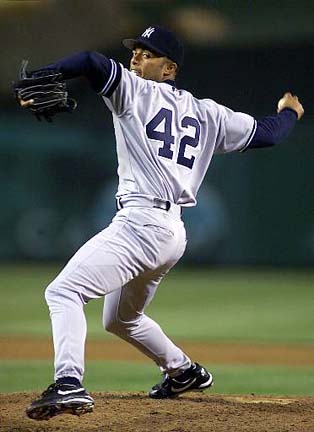
The best relief pitcher in baseball is Mariano Rivera of the New York Yankees. He is the epitome of calm out there on the mound. The specialist called in to preserve his team’s lead, to record the win. To bang in the final nail in the coffin of the opposing team’s hopes. Never rushed, always self-assured, always sticking to the plan—that’s Mariano Rivera.

Strangely, the man has only one kind of pitch, but he throws it with such quality and such consistency and such accuracy that it is largely un-hittable.

If I were the Mariano Rivera of writers, I would likely still be working on the first draft. I would be courageous and confident, not wondering about the final outcome of the game, focusing instead only on the very next pitch/page. I would not be worried whether or not I had included in the story all the elements I wanted, nor agonizing over whether the writing was any good, and how others would judge my performance.

But I am not Mariano Rivera so I have done all those things.

First draft done.

Final score not yet in.


0 Comments
<<Previous


    ​Author

    Brian d'Eon, fiction writer: whose work modulates between speculative, historical and magical realism.

    Categories

    All
    1917
    2010
    Ainsworth
    Albert Einstein
    Apollo XI
    Astronomer
    Baillie Grohman
    Baillie-Grohman
    Begbie
    Big Ledge
    Blade Runner 1982
    Blade Runner 2049
    Bluebell Mine
    Book Review
    British Colonist
    Bruce Dern
    Capitalism Vs Climate
    Chapbook
    Civilization
    Climate Change
    Cosmology
    C.S. Lewis
    Dandelions
    Davie
    Dead Crow
    D'Eon
    Deon
    Diana Morita Cole
    Draper Catalogue
    Dreams
    E-books
    Economics
    Editing
    Eileen Delehanty Pearkes
    Eta Carinae
    Fassbender
    Flashbacks
    Gravity
    Gray
    Green Manifesto
    Grohman
    Guess Who's Back?
    Hammill
    Harold Fry
    Hayao Miyazaki
    Hendryx
    Hitler
    Internees
    Isaac Newton
    Jamaica
    Jfk
    Jobs Vs Environment
    John Keats
    Kenneth Clark
    Kootenays
    Korolev
    Lily Langtry
    Lunatics
    Mark Twain
    Matt Haig
    Mikado
    Millet
    Nebraska Movie
    Nelson
    Nixon
    Novel
    Novel Drafts
    Novella
    Novel Structure
    Opium
    Oscar Nominees
    Photography
    Pitch
    Plague
    Point Of View
    Primack & Abrams
    Publishers
    Queenie Hennessy
    Rachel Joyce
    Rejection
    Review
    Richard Bausch
    Sam Mendes
    Saoirse Ronan
    Science And Religion
    Science Literacy
    Sean Arthur Joyce
    Serkis
    Shakespeare
    Sideways
    Sinixt
    Sproule
    Sputnik
    Steamer
    Stranger Things
    Submissions
    Sweet Melancholy
    Telescope
    The Humans
    The Price Of Transcendence
    The Wind Rises
    Travel
    Treasure Beach
    Van Gogh
    Victoria
    View From The Center Of The Universe
    Von Braun
    Winter Photos
    Yeats

    Archives

    February 2022
    October 2020
    July 2020
    June 2020
    April 2020
    February 2020
    June 2019
    October 2018
    April 2018
    March 2018
    February 2018
    January 2018
    October 2017
    May 2017
    March 2017
    February 2017
    January 2017
    July 2016
    February 2016
    January 2016
    November 2015
    July 2015
    June 2015
    May 2015
    April 2015
    December 2014
    November 2014
    May 2014
    April 2014
    March 2014
    January 2014
    December 2013
    November 2013
    August 2013
    July 2013
    June 2013
    May 2013
    April 2013
    March 2013
    February 2013
    January 2013
    December 2012
    November 2012

Powered by Create your own unique website with customizable templates.